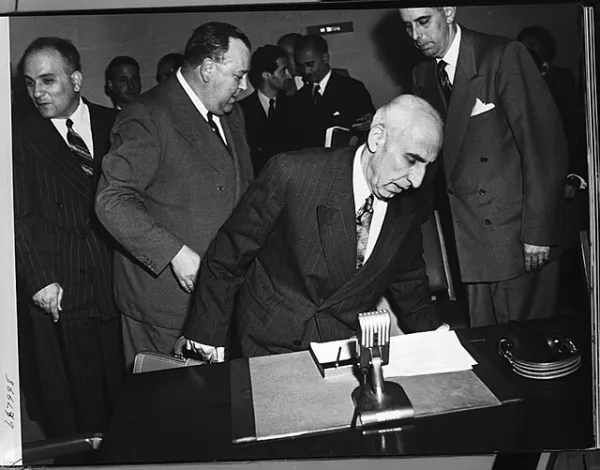
Prime Minister Mohammad Mossadegh of Iran takes his seat at the United Nations Security Council in New York City. From photograph album "Visit of his Excellency Mohammad Mossadegh, Prime Minister of Iran, to the United States of America, October 8 to November 18, 1951." Harry S. Truman Presidential Library and Museum, Public domain, via Wikimedia Commons
“So this is how we get rid of that madman Mossadegh.”
In the summer of 1953, Secretary of State John Foster Dulles reportedly held up a copy of a top-secret plan—Operation Ajax—and made that declaration. The operation, engineered by the United States and Great Britain, overthrew Iran’s democratically elected prime minister, Mohammad Mossadegh. In his place, Washington and London restored Mohammad Reza Pahlavi, a monarch whose rule would last 26 years and whose regime would become synonymous with repression, inequality, and dependency on Western power.
Dulles delivered the news in his characteristically brisk and forceful manner. Applause reportedly followed. President Dwight D. Eisenhower and senior policymakers regarded the coup as a triumph of American resolve against Soviet influence. In Washington, it was celebrated as strategic genius. In Iran, it planted the seeds of lasting resentment. For his service, Dulles would later receive the Presidential Medal of Freedom—America’s highest civilian honor.
History, however, has a long memory.
In 1979, the Iranian Revolution swept away the Shah. The collapse of the Pahlavi monarchy was not sudden; it was the culmination of decades of political suffocation and social discontent. The revolution represented an organic crisis of the old order. Popular, anti-imperialist energies surged into the streets. Yet the outcome was paradoxical: the Islamic Republic emerged as a new state form that absorbed those energies while preserving structures of domination under a different ideological banner. The monarchy fell, but hierarchy endured—reconstituted through theocratic authority.
More than seven decades after Operation Ajax, history appears to echo.
Following the Twelve-Day War in June 2025, President Donald Trump announced that U.S. forces had “completely and totally obliterated” Iran’s key nuclear enrichment facilities in airstrikes codenamed Operation Midnight Hammer. President Donald Trump in a televised address to the nation on Saturday, February 28, 2026, he justified the campaign by invoking “imminent threats” posed by Tehran. "Our objective is to defend the American people by eliminating imminent threats from the Iranian regime, a vicious group of very hard, terrible people".
Yet the public record tells otherwise. Rafael Grossi, head of the International Atomic Energy Agency, stated in an interview with a French network that inspectors had seen no evidence that Iran was preparing to build a nuclear weapon. Officials speaking to The New York Times confirmed that no new nuclear sites had been constructed since the June strikes, and there was no indication that Iran was attempting to weaponize its enriched uranium stockpile. “There is no imminent threat,” wrote Daryl G. Kimball of the Arms Control Association. “Iran is not close to weaponizing its nuclear material so as to justify another U.S. attack.”
If there was no imminent threat, then why launch a war—one not authorized by Congress and opposed by much of the American public? Critics point to the influence of Israeli Prime Minister Benjamin Netanyahu and powerful pro-Israel lobbying networks in Washington. For years, Netanyahu has framed Iran as the central obstacle to Israeli strategic dominance in the Middle East. From Iraq to Syria to Lebanon, regional adversaries have been weakened or fragmented. Iran remains the principal counterweight.
The killing of Iran’s Supreme Leader and other senior officials on the first day of the strikes signals an objective that goes beyond nuclear containment or missile development. The aim appears not merely deterrence, but regime change—or at least regime realignment in accordance with U.S.–Israeli strategic interests.
The consequences are profound. Far from stabilizing the region, the war has intensified volatility across the Middle East, unleashed widespread destruction, and claimed the lives of hundreds of civilians already suffering from decades of economic sanctions. More consequential still, it threatens to reshape the internal trajectory of Iranian politics. External military aggression has historically consolidated hardline power within Iran, enabling ruling elites to rally nationalist sentiment while suppressing dissent. In doing so, it marginalizes progressive and grassroots movements striving to build a pluralistic and democratic Iran, narrowing the political space for genuine reform.
In 1953, Washington believed it had solved the “Iran problem” with a covert operation. Trump appears to believe he can do so again with missiles and airstrikes. But history suggests a sobering lesson: foreign intervention in Iran has rarely produced democracy, stability, or gratitude. More often, it has produced cycles of resentment, authoritarian retrenchment, and unintended consequences that endure for generations.
If the past is any guide, this war will not end the story. It may only deepen it.
Contact Information:
Nader Rahimi
Email: nrahimi@bu.edu